10 Pillars of AI Analysis
In the high-stakes arena of stock trading do not rely solely on technical analysis
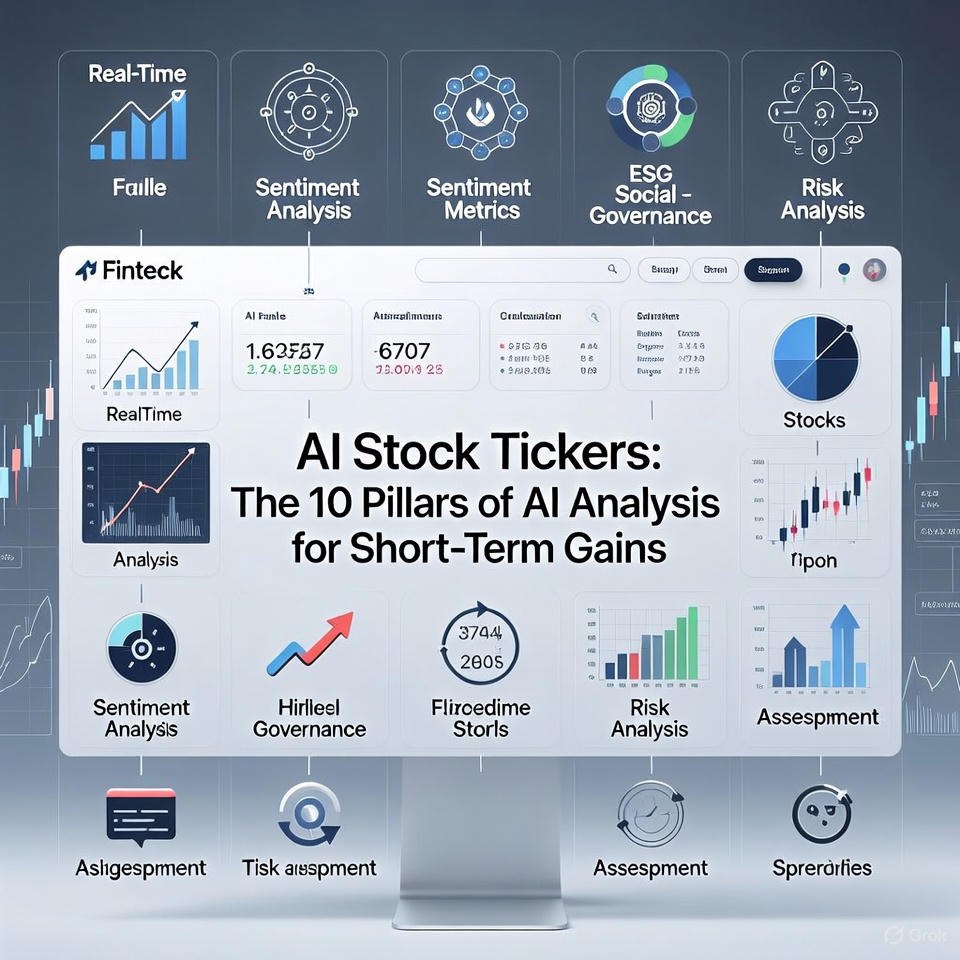
The 10 Pillars of AI Analysis: Why Technicals Aren't Enough
In the high-stakes arena of stock trading, where fortunes can swing on a single headline or economic whisper, relying solely on technical analysis is like navigating a storm with only a compass—no radar, no satellite imagery, just lines on a chart. Traditional traders have long leaned on price patterns, moving averages, and volume indicators to predict short-term moves. While these tools offer valuable insights into market momentum, they often fall short in capturing the full spectrum of influences driving stock prices. Enter AI Stock Tickers' proprietary "10 Pillars" methodology—a revolutionary, multi-faceted AI-driven framework that integrates visible and "invisible" factors to uncover high-probability opportunities for 2-4 week gains. Drawing from the platform's detailed methodology and broader financial knowledge, this post dives deep into why technicals alone aren't enough and how the 10 Pillars provide a more comprehensive edge.
The Limitations of Technical Analysis: A Narrow Lens in a Complex Market
Technical analysis, rooted in the work of pioneers like Charles Dow in the late 19th century, focuses on historical price and volume data to forecast future movements. Tools like Relative Strength Index (RSI), Moving Average Convergence Divergence (MACD), and candlestick patterns help identify trends, support/resistance levels, and potential reversals. In efficient markets, these can signal entry and exit points effectively, especially in liquid assets.
However, technicals have inherent blind spots. Markets aren't purely rational; they're influenced by human psychology, external events, and asymmetric information. For instance, a bullish head-and-shoulders pattern might fail spectacularly if a geopolitical crisis erupts or if insiders start dumping shares—factors invisible on a chart. Studies, such as those from the CFA Institute, show that technical strategies underperform during volatile periods because they ignore fundamentals, sentiment shifts, and macro drivers. In today's data-rich environment, where alternative datasets like social media buzz or satellite imagery can predict earnings surprises, sticking to technicals alone is akin to ignoring 90% of the puzzle. This is where AI Stock Tickers' 10 Pillars shine, blending technicals with nine other dimensions to create a holistic, adaptive system that mitigates these gaps.
Introducing the 10 Pillars: A Holistic AI Framework
AI Stock Tickers' methodology isn't just an algorithm—it's an integrated intelligence engine that processes vast datasets in real-time, uncovering non-linear interactions that humans or single-factor models might miss. By synthesizing insights from ten interconnected pillars, the AI identifies stocks primed for short-term surges, emphasizing risk-adjusted returns. This approach recognizes that market movements are a symphony of factors: a positive earnings report (fundamentals) might amplify social buzz (sentiment), but only if macro conditions (like interest rates) align and no ESG scandals loom.
The pillars are designed for synergy—signals from one reinforce or contradict others, generating a composite score. This multi-factor strategy draws from quantitative finance principles, where models like Fama-French expand beyond beta to include size, value, and momentum. But AI Stock Tickers takes it further with machine learning, enabling dynamic adaptation to market regimes, from bull runs to corrections.
1. Fundamentals: The Bedrock of Value
At the core are a company's financial vitals—earnings, revenue, expenses, and surprises relative to analyst expectations. Unlike long-term value investing (e.g., Warren Buffett's style), the focus here is on short-term catalysts like quarterly reports that can trigger immediate volatility. AI evaluates PE ratios for mispricings and scans macroeconomic ties, such as how inflation affects margins. Why it matters: Technicals might show a breakout, but weak fundamentals could signal a trap.
2. Technicals: The Visible Momentum Driver
Yes, technicals are included—but as one pillar, not the whole story. Price action, volume spikes, and indicators like RSI or stochastics detect overbought/oversold states and patterns (e.g., wedges, flags). Advanced AI models apply fractal geometry or Fourier transforms for deeper predictions. Alone, technicals capture 20-30% of variance in returns (per academic studies); combined with others, they become exponentially more reliable.
3. Sentiment Data: Capturing the Market's Mood
One of the "invisible" stars—sentiment analysis uses NLP to parse news, Reddit threads, Twitter (X) posts, and forums for tone and volume. Metrics like Put/Call ratios or VIX gauge fear/greed. Behavioral finance shows how optimism cascades into self-fulfilling rallies; AI spots these shifts early, turning herd mentality into an edge. Technicals ignore this psychological layer, often leading to false signals during hype cycles like meme stock frenzies.
4. Macro Drivers: The Big Picture Context
Interest rates, GDP growth, inflation, and geopolitics (e.g., trade wars) can override any chart pattern. This pillar integrates economic indicators and industry trends, forecasting how Fed decisions might impact sectors. In 2022's bear market, macro ignorance cost technical traders dearly; AI Stock Tickers' system contextualizes technical setups within these broader forces.
5. AI Quant: The Computational Powerhouse
Machine learning algorithms crunch datasets for predictive patterns, backtesting strategies, and optimizing portfolios. Techniques like random forests or neural networks uncover correlations humans miss, such as entropy-based features for volatility prediction. This pillar acts as the "brain," orchestrating the others for data-driven precision.
6. ESG Factors: Ethical and Sustainable Insights
Environmental (e.g., carbon footprints), Social (diversity, labor practices), and Governance (board ethics) scores reveal hidden risks. With investors increasingly prioritizing sustainability—BlackRock's trillions in ESG funds attest to this—a low ESG rating can tank a stock post-scandal. Technicals don't flag these; AI does, spotting opportunities in green transitions.
7. Moat Analysis: Defending Competitive Edges
Inspired by Buffett's "economic moats," this evaluates barriers like patents, brand loyalty, or network effects. For short-term plays, it assesses if a moat protects against disruptions, like how Tesla's tech ecosystem buffers against competitors. Invisible to charts, weak moats can erode gains quickly.
8. Risk Metrics: Safeguarding Against Downside
Volatility isn't just noise—it's quantifiable via beta, VaR, drawdowns, and Sharpe ratios. This pillar ensures picks are risk-adjusted, recommending stop-losses and position sizes. In volatile markets, technical breakouts often reverse; integrating risk prevents wipeouts.
9. Insider Activity: Signals from the Inside
Executive buys/sells, buybacks, and institutional flows indicate confidence. SEC filings reveal these; AI tracks patterns, like clustered insider buying preceding rallies. This "invisible" alpha—studies show insiders outperform markets by 5-10% annually—complements technicals by validating momentum.
10. Event Catalysts: Timing the Triggers
Mergers, product launches, or regulatory nods can spark explosive moves. This pillar scans calendars for upcoming events, modeling impacts. Technicals might lag; AI anticipates, turning events into timely setups.
The Workflow: From Data to Actionable Insights
The 10 Pillars aren't static—they flow through a streamlined, AI-orchestrated process:
- Data Ingestion & Preprocessing: Real-time feeds from APIs pull traditional (prices, financials) and alternative data (social sentiment, satellite imagery for retail traffic). Cleaning ensures accuracy, addressing biases.
- Multi-Factor Analysis: AI models cross-reference pillars, detecting synergies (e.g., sentiment boosting fundamentals) for 2-4 week predictions.
- Ranked Picks & Risk Integration: Daily outputs include signals, targets, and risk guides, prioritizing high-conviction, low-drawdown opportunities.
- Continuous Refinement: Models retrain on new data, adapting to shifts like AI hype in 2023.
This API-first, low-latency system democratizes institutional-grade analysis for retail traders.
Data Sources: Blending Traditional and Alternative for Depth
Traditional sources (exchange data, economic reports) provide structure, while alternatives (credit card trends, app metrics, logistics) offer real-time proxies. For example, satellite data predicted Walmart's strong quarters by monitoring parking lots—insights technicals can't touch.
Why This Matters: Outperforming in Uncertainty
In an era of flash crashes and meme-driven volatility, the 10 Pillars methodology outperforms by addressing technicals' myopia. Backed by ML's ability to handle big data (as seen in hedge funds like Two Sigma), it captures the "invisible" 70% of market drivers. Limitations? AI depends on data quality and can't predict true black swans, but continuous learning minimizes this.
For traders tired of chart-only pitfalls, AI Stock Tickers' approach is a paradigm shift. Dive deeper on their methodology page or explore their tools to see the pillars in action. In trading, knowledge is power—make it multi-dimensional.
About AI Stock Tickers
AI Stock Tickers is a financial technology expert specializing in AI-driven market analysis and algorithmic trading strategies. With years of experience in quantitative finance, they provide insights into the intersection of artificial intelligence and financial markets.