Deep Dive into AI Stock Tickers Methodology
This blog post delves into AI Stock Tickers' innovative methodology for short-term stock picks, highlighting its multi-factor AI framework across 10 key pillars
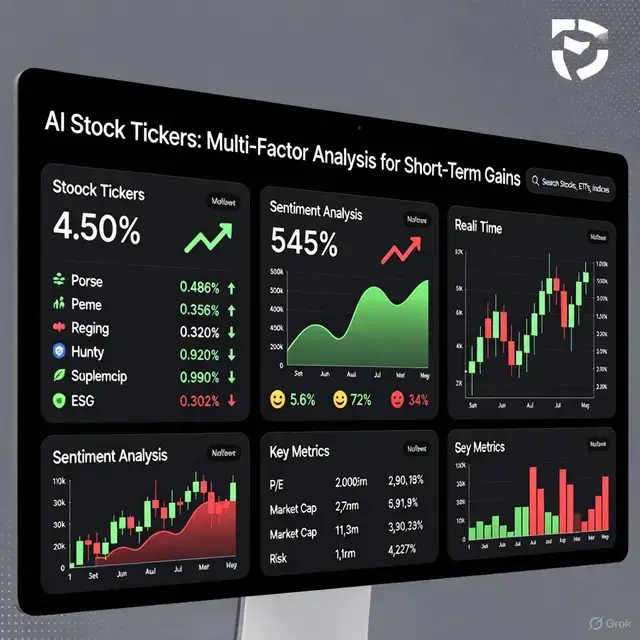
Demystifying AI Stock Tickers: A Deep Dive into Their Methodology
In the fast-paced world of stock trading, AI-driven tools are revolutionizing how investors identify opportunities. One such platform, AI Stock Tickers, employs a sophisticated methodology to generate short-term stock picks aimed at 2-4 week gains. This blog post breaks down their approach, based on a review of their publicly available methodology, to help you understand how it works and its potential strengths and limitations.
The Core Philosophy: A Multi-Faceted AI Framework
At its heart, AI Stock Tickers' methodology is built on a holistic, integrated multi-factor approach that combines quantitative data with qualitative insights. Unlike traditional single-factor analyses, it draws from ten key disciplines—fundamentals, technicals, sentiment data, macro drivers, AI quant, ESG factors, moat analysis, risk metrics, insider activity, and event catalysts—to spot high-probability stock setups. This strategy acknowledges the complex, non-linear interactions in markets, such as how an earnings surprise might amplify positive sentiment or how geopolitical events could override technical patterns.
The goal? To provide modern traders with precise, speedy insights into stocks poised for significant short-term movements. By leveraging machine learning, the system processes vast datasets in real-time, overcoming human biases and computational constraints to forecast values and generate trading signals.
The 10 Pillars: Breaking Down the Analysis Components
The methodology revolves around these ten pillars, each contributing unique signals that are cross-referenced for robust predictions:
- Fundamentals: Focuses on a company's financial health, emphasizing short-term catalysts like earnings reports, revenue surprises, PE ratios, and analyst estimates. Real-time evaluation of releases and macroeconomic influences ensures timely relevance.
- Technicals: Examines price action, volume, and patterns using indicators like moving averages, RSI, and stochastic oscillators. Advanced mathematical models enhance chart analysis for breakout predictions.
- Sentiment Data: Tracks market mood through metrics like Put/Call ratios, VIX, and social media buzz. Natural Language Processing (NLP) and machine learning analyze news, Reddit, and Twitter to detect sentiment shifts and behavioral momentum.
- Macro Drivers: Incorporates broader economic factors such as interest rates, inflation, GDP growth, geopolitical events, and industry trends that could sway stock performance.
- AI Quant: Employs machine learning for predictive analytics, backtesting, and optimization, turning raw data into quantifiable insights.
- ESG Factors: Assesses environmental, social, and governance elements—like sustainability practices and ethical compliance—to identify risks or opportunities.
- Moat Analysis: Evaluates a company's competitive advantages, such as patents, brand strength, or network effects, to gauge long-term defensibility in short-term contexts.
- Risk Metrics: Measures volatility and downside risks using tools like beta, Value at Risk (VaR), and drawdown analysis, prioritizing risk-adjusted returns.
- Insider Activity: Monitors executive trades, buybacks, and institutional holdings as indicators of internal confidence.
- Event Catalysts: Pinpoints triggers like mergers, product launches, or regulatory approvals that could spark rapid price changes.
This integrated engine dynamically adjusts to market conditions, ensuring that signals from one pillar reinforce or contradict others for a comprehensive score.
The Step-by-Step Process: From Data to Daily Picks
The workflow is a streamlined, automated pipeline designed for accuracy in short-term trading:
- Data Ingestion and Preprocessing: Pulls real-time and historical data from diverse sources via APIs, including market prices, financial statements, economic indicators, sentiment from social platforms, and alternative data like satellite imagery or app usage stats. Data is cleaned, standardized, and tokenized to eliminate noise—crucial for detecting subtle signals.
- Multi-Factor AI Analysis: The preprocessed data feeds into AI models that scan across the ten pillars. These models identify patterns, correlations, and anomalies, generating predictions for 2-4 week horizons while accounting for interdependencies.
- Ranked Picks and Risk Integration: Outputs daily stock rankings with buy/sell signals, target prices, and risk guidance (e.g., position sizing, stop-loss levels). Emphasis is on risk-adjusted opportunities to protect against volatility.
- Continuous Learning: Models are iteratively retrained with new data and past performance feedback, adapting to evolving market dynamics—like refining sentiment analysis during volatile periods.
This process relies on an API-first approach for low-latency access, blending traditional financial data with alternative sources to uncover hidden edges.
Data Sources: Traditional Meets Alternative
A standout feature is the diverse data ecosystem:
- Traditional: Real-time prices, options data, fundamentals (EPS, analyst estimates), and economic indicators (GDP, CPI).
- Alternative: Sentiment from social media (via NLP), consumer spending trends from credit cards, satellite-derived insights (e.g., retail traffic), app engagement metrics, logistics data, and public filings.
This mix allows for pre-announcement signals and a fuller market picture, though it depends on API reliability and data quality.
Limitations and Considerations
While innovative, the methodology isn't flawless. It heavily relies on data accuracy and availability, which could introduce errors if sources falter. The short-term focus (2-4 weeks) may not suit long-term investors, and the black-box nature of AI models could obscure decision-making. Additionally, external factors like sudden market shocks might challenge predictions, underscoring the need for human oversight.
Overall, AI Stock Tickers' methodology represents a cutting-edge blend of AI and multi-factor analysis, offering traders a powerful tool for navigating volatile markets. If you're exploring AI in investing, this approach highlights the potential of data-driven precision—but always remember, no system guarantees profits. For more details, check out their official page!
About AI Stock Tickers
AI Stock Tickers is a financial technology expert specializing in AI-driven market analysis and algorithmic trading strategies. With years of experience in quantitative finance, they provide insights into the intersection of artificial intelligence and financial markets.