Evolution of Stock Market Analysis
Explore the historical progression of AI in stock market analysis, from early human-centric methods to modern, adaptive systems like AI Stock Tickers
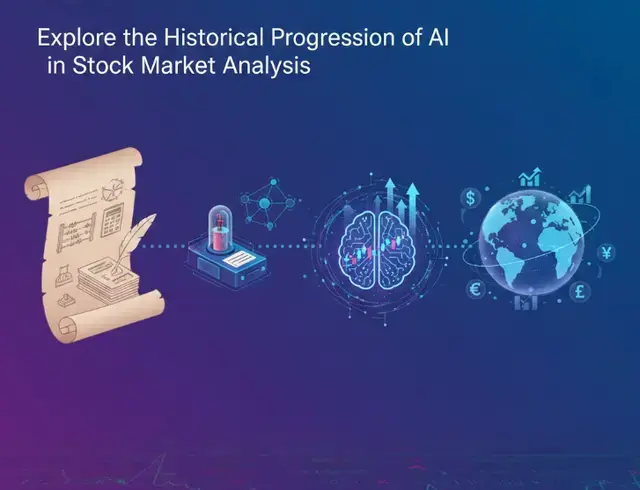
The Evolution of AI in Stock Market Analysis: From Human Intuition to Intelligent Algorithms
In today's volatile stock markets, where split-second decisions can make or break fortunes, artificial intelligence (AI) has emerged as a game-changer. Platforms like AI Stock Tickers are at the vanguard, harnessing AI to deliver precise, short-term stock picks for 2-4 week gains. Drawing from the insights on AI Stock Tickers' evolution page and broader historical context, this blog post explores how AI has transformed stock market analysis—from its rudimentary beginnings to the sophisticated, data-driven systems we see today.
The Foundations: Human-Driven Analysis and Its Limits
Stock market analysis has roots stretching back centuries, but for much of the 20th century, it relied heavily on human expertise. Analysts pored over fundamental reports like balance sheets, income statements, and cash flow projections, while technical traders scrutinized price charts and volume patterns for trends. Tools like moving averages and RSI (Relative Strength Index) were manual calculations, often plotted on graph paper.
However, these methods had glaring limitations. Humans could only process so much data, and markets generate terabytes of information daily. Complex, non-linear relationships—such as how geopolitical events interplay with earnings reports—were hard to spot intuitively. Behavioral biases, like overconfidence or herd mentality, further clouded judgments. As markets globalized in the 1980s and 1990s, the need for faster, more objective tools became evident.
The Dawn of Automation: Rule-Based Systems
The first major shift came with algorithmic trading in the late 20th century. Pioneered by firms like Renaissance Technologies in the 1980s, these systems used predefined rules: for instance, buy if a stock's price crosses above its 50-day moving average or if the P/E ratio drops below a certain threshold. This brought speed and consistency, eliminating emotional decisions and enabling high-frequency trading (HFT) that now accounts for over 50% of U.S. equity trades.
Yet, rule-based systems were rigid. They couldn't adapt to black swan events like the 2008 financial crisis or uncover hidden patterns in vast datasets. Enter machine learning (ML) in the early 2000s—a paradigm shift where algorithms "learn" from historical data. By analyzing decades of price movements, volumes, and financial reports, ML models identify predictive relationships, such as how earnings growth combined with low debt levels often precedes stock rallies. This evolution mirrored broader AI advancements, like those in chess (Deep Blue in 1997) and image recognition, applying similar neural networks to finance.
Expanding Horizons: Sentiment and Alternative Data
As AI matured, it began incorporating unconventional data sources to capture the market's multifaceted nature. Sentiment analysis, powered by Natural Language Processing (NLP), revolutionized this. Instead of just keywords, AI now deciphers tone and context from news articles, social media platforms like Reddit and Twitter (now X), and earnings transcripts. For example, a surge in positive buzz on StockTwits can signal behavioral momentum, creating self-fulfilling prophecies in short-term trades.
Beyond sentiment, alternative data streams provide real-time edges. Anonymized credit card transactions reveal consumer spending trends, satellite imagery tracks retail foot traffic or crop yields, and logistics data monitors supply chains. These proxies can predict earnings surprises before official announcements—think how satellite photos of oil tankers helped forecast commodity prices during the COVID-19 disruptions. This integration reflects AI's ability to handle "big data," a concept popularized in the 2010s with Hadoop and cloud computing.
Towards Holistic AI: Integration and Adaptation
Modern AI in stock analysis is holistic and adaptive. It fuses traditional data (financials, technicals) with sentiment, macroeconomic factors, and alternatives into multi-factor models. These systems detect interactions and anomalies—for instance, how a tariff announcement might nullify a bullish technical pattern. Continuous learning from new data and outcomes refines predictions, much like how AlphaGo evolved through self-play in 2016.
Risk management has also advanced: AI calculates metrics like Sharpe Ratio (risk-adjusted return) and Maximum Drawdown, recommending position sizes and stop-losses to navigate short-term volatility. Challenges remain, though—data privacy concerns (e.g., GDPR compliance), model overfitting, and ethical issues like market manipulation via AI-driven flash crashes (as seen in 2010).
AI Stock Tickers: Pioneering the Next Wave
AI Stock Tickers exemplifies this evolution, building on these foundations to offer a platform tailored for short-term traders. Their system ingests real-time datasets across ten critical areas, using ML for pattern recognition, NLP for sentiment, and alternative data for hidden insights. Key features include adaptive learning systems that refine based on market feedback, automated risk tools, and multi-factor analysis that cuts through noise for high-probability setups.
As highlighted on their page, this approach empowers traders to unlock profits in volatile environments, representing "next-generation intelligence." It's a far cry from early manual methods, emphasizing precision and speed in a world where traditional analysis falls short.
Looking Ahead: The Future of AI in Markets
The evolution isn't over. Emerging technologies like quantum computing could process exponentially more data, while advanced neural networks (e.g., transformers from GPT models) might enhance predictive accuracy. Real-time global data processing could further democratize access, but it also raises questions about inequality—will AI widen the gap between retail and institutional traders?
In summary, AI's journey in stock market analysis—from human limits to intelligent, adaptive systems—has democratized sophisticated trading. Platforms like AI Stock Tickers are not just tools; they're the future, blending history's lessons with cutting-edge tech. Whether you're a seasoned investor or a newbie, understanding this evolution can sharpen your edge. For more, dive into their methodology or evolution page!
About AI Stock Tickers
AI Stock Tickers is a financial technology expert specializing in AI-driven market analysis and algorithmic trading strategies. With years of experience in quantitative finance, they provide insights into the intersection of artificial intelligence and financial markets.